Sections

Monday, August 15, 2011

RSC Shakespeare's Language - Prose

Prose

The convention in Shakespeare's time was to write plays in verse. His extensive use of prose is yet another sign of his inventiveness and capacity to break with custom when it served his plan.

He uses prose for a variety of purposes. Often lower class or comic characters speak prose while the more socially or morally elevated characters speak in verse, but this is far from always the case. Some of Hamlet's most important speeches, such as his advice to the players, are in prose. In Julius Caesar, Brutus chooses prose over verse when he sets out to convince the citizens that the conspirators were right to murder Caesar.

Why does Shakespeare shift from verse to prose? The conversational tone of prose can make a character seem more natural at a particular moment or it can indicate the degeneration of a noble nature as it does with Othello. A swift movement from prose to poetry or the reverse is always an indication that a change is taking place. Shakespeare is remarkably skillful in his flexible use of verse forms and prose.

While verse is more formally structured than prose, prose is not necessarily more free from rules. In fact, prose can be more subtly and sometimes more artificially structured than verse. Shakespeare regularly uses a number of rhetorical devices to give his prose form and coherence. Important among these are alliteration, assonance, repetition, antithesis, lists and puns. These are described briefly below. These also appear in verse. Most of them are employed in Brutus's speech, which begins:

BRUTUS

Romans, countrymen, and lovers, hear me for my cause and be silent

that you may hear. Believe me for mine honour, and have respect to

mine honour, that you may believe. Censure me in your wisdom, and

awake your senses that you may the better judge. If there be any in

this assembly, any dear friend of Caesar's, to him I say that Brutus'

love to Caesar was no less than his. If then that friend demand why

Brutus rose against Caesar, this is my answer: not that I loved Caesar

less, but that I loved Rome more..

RSC Shakespeare's Language - Rhymed Verse

Rhymed verse

While blank verse forms the basis of Shakespeare's writing, he often uses rhyme. Frequently a rhymed couplet (a pair of lines whose end words rhyme) closes the scene and sometimes suggests what will come next:

HAMLET The play's the thing

Wherein I'll catch the conscience of the King.

Shakespeare uses rhyme and a variety of rhythm patterns to distinguish special characters such as the witches in Macbeth and Puck in A Midsummer Night's Dream. 'Double, double, toil and trouble / Fire burn and cauldron bubble,' chant the witches . In addition to the rhyme, notice that this is not an iambic line, being only four feet long and with the stresses reversed from the iambic. Shakespeare has created a special musical rhythm for these supernatural characters.

Shakespeare also uses rhyme to make comments and for special occasions such as songs and epilogues. Puck in A Midsummer Night's Dream and Prospero in The Tempest say farewell to the audience in rhyme.

Rhyme is a clue to character or situation. It is always helpful to ask why Shakespeare is using rhyme at a particular point and what effect it has.

Shakespeare's many songs use rhymed verse.

RSC Shakespeare's Language - Blank Verse

Blank verse

Both written and spoken language use rhythm - a pattern of stressed and unstressed syllables. Most forms of poetry or verse take rhythm one step further and regularise the rhythm into a formal pattern of stressed and unstressed syllables. A formal pattern of rhythm is called metre.

Shakespeare writes either in blank verse, in rhymed verse or in prose. Blank verse is unrhymed but uses a regular pattern of rhythm or metre. In the English language, blank verse is iambic pentameter. Pentameter means there are five poetic feet. In iambic pentameter each of these five feet is composed of two syllables: the first unstressed; the second stressed.

The opening line of Twelfth Night, is a perfect iambic line :

'If music be the food of love play on'

With its unstressed and stressed syllables marked or 'scanned', it looks like this:


/ / ں ں / / ں / ں /

'If mu sic be the food of love play on'

/ = strong weak = ں

The rhythm of blank verse is conversational and with its dee DUM, dee DUM, dee DUM, dee DUM, dee DUM rhythm, it imitates the heartbeat.

In conversation, we often break the rhythmic pattern and this throws specific words into focus. Shakespeare does the same with blank verse: he often deviates from the perfect iambic line. When he does, it's a clue to a change in the character's feelings or thoughts or a change in situation or both. When the rhythm is changed, the energy and dynamic of the language have been changed. Feel how abrupt, uneven and ragged the rhythm is in the final scenes of Macbeth – here, Macbeth's last hope is dashed and Birnam Wood is seen to move to Dunsinane:

MACBETH

ں / ں / ں / ں / ں /

Throw physic to the dogs; I'll none of it.

/ / ں / ں / ں / ں /

Come, put mine armour on; give me my staff.

/ ں ں / / ں ں / ں / ں

Seyton, send out. Doctor, the thanes fly from me.

/ / ں /

Come, sir, dispatch.

King Lear's anguished protest against the murder of Cordelia (and perhaps of the Fool as well) reverses the rhythmic order of the syllables as Lear's world itself has been incomprehensibly upended:

/ ں / ں / ں / ں / ں

KING LEAR Never, never, never, never, never.

In addition to the repetition of 'never,' the emphasis on the first syllables of each foot suggests a blocking, a refusal to accept the unacceptable. The unstressed syllable ending each foot communicates a sense of hopelessness.

When the line ends in an unstressed syllable rather than a stressed one, as is usual with iambic pentameter, this is sometimes called a feminine or weak ending. Several lines ending in unstressed syllables in a speech call for investigation on the part of the reader. Consider the opening lines of Othello's speech to the Venetian Senate:

OTHELLO

ں /ں / ں /ں /ں

Most potent, grave and reverend signiors,

ں /ں /ں / ں / ں / ں

My very noble and approved good masters,

ں / ں / ں/ ں / ں / ں

That I have ta'en away this old man's daughter,

ں / ں / ں / ں / ں /

It is most true; true I have married her.

ں /ں / ں / ں / ں / ں

The very head and front of my offending

ں / ں / ں /

Hath this extent, no more...

What accounts for this series of weak endings? Is Othello feeling defensive in putting his case to the senators? Or is he, with irony, subtly undermining their power and status? Or is there another reason? This is an actor's choice, but a choice that will have vital implications for characterisation.

Just as an actor will 'beat through' the verse (for example, by clapping), when looking for clues to his character's state of being, so students of Shakespeare can benefit from beating out the rhythms of the verse and considering what might explain deviations from the iambic line.

What is iambic pentameter?

Follow the link below to a useful BBC Learning Zone video showing students learning about meter.


http://www.bbc.co.uk/learningzone/clips/what-is-iambic-pentameter/9891.html

Handy glossary of literary terms

http://www.english.cam.ac.uk/vclass/terms.htm

Does the play Othello belong to the character Iago or Othello?


Read how Laurence Olivier’s performance of Othello in 1964 radically reimagined the character Othello as a narcissistic and self-dramatising character.

It took careful wooing to talk Olivier into Othello, the only major role in Shakespearean tragedy that he had not played. He pointed out that no English actor in this century had succeeded in the part. The play, he said, belonged to Iago, who could always make the Moor look a credulous idiot. “If I take it on,” he said, “I don't want a witty, Machiavellian Iago. I want a solid, honest-to-God N.C.O.” The director, John Dexter, fully agreed with this approach.

Soon afterwards I passed on the news to Orson Welles, himself a former Othello, He voiced an instant doubt. “Larry's a natural tenor,” he rumbled, “and Othello's a natural baritone.” When I mentioned this to Olivier there followed weeks of daily voice lessons that throbbed through the plywood walls of the National Theatre's temporary offices near Waterloo Bridge. When the cast assembled to read the play Olivier's voice was an octave lower than any of us had ever heard it.

Dexter (the director) in his preliminary speech before rehearsals began declared pride to be the key to all the characters, especially to that of Othello; already he was touching on the theme that was to be the concealed mainspring of the production – the idea of Othello as a man essentially narcissistic and self-dramatising.

“Othello,” Dexter told the cast, is a pompous, word-spinning arrogant black general. At any rate, that's how you ought to see him. The important thing is not to accept him at his own valuation. Try to look at him objectively. He isn't just a righteous man who's been wronged. He's a man too proud to think he could ever be capable of anything as a base as jealousy. When he learns that he can be jealous, his character changes. The knowledge destroys him, and he goes berserk. Now let's have a good loud reading this afternoon.”

The first read through was a shattering experience. Normally on these occasions the actors do not exert themselves. They sit in a circle and mumble, more concerned with getting to know one another than with giving a performance. Into this polite gathering Olivier tossed a hand-grenade. He delivered the works – a fantastic, full-volume display that scorched one's ears, serving final notice on everyone present that the hero, storm-centre and focal point of the tragedy was the man named in the title. Seated, bespectacled and lounge-suited, he fell on the text like a tiger. This was not a noble, “civilised” Othello but a triumphant black despot, aflame with unadmitted self-regard. So far from letting Iago manipulate him, he seemed to manipulate Iago, treating him as a kind of court jester. Such contumely cried out for deflation.

There are moral flaws in every other Shakespearean hero, but Othello is traditionally held to be exempt. Olivier's reading made us realise that tradition might be wrong; that Othello was flawed indeed with the sin of pride. At the power of his voice, the windows shook and my scalp tingled. A natural force had entered the room, stark and harsh, with vowel-sounds subtly alien as Kwame Nkrumah's; and the cast listened pole-axed.

I wondered at the risks he was taking. Mightn't the knock down arrogance of this interpretation verge to closely for comfort on comedy? Wasn't he doing to Othello precisely what he deplored in the Peter Brook - Paul Schofield “King Lear” – i.e. cutting the hero down to size and slicing away his majesty? Then he came to “farewell the plumed troop,” and again the hair rose on my neck. It was like the dying moan of a fighting bull.

Like the cast, I was awed, We were learning what it meant to be faced with a great classical actor in full spate – one whose vocal range was so immense that by a single new inflection he could point the way to a whole new interpretation. Every speech, for Olivier, is like a mass of marble at which the sculptor chips away until its essential form and meaning are revealed. No matter how ignoble the character he plays, the result is always noble as a work of art.’

Sam Mendes discusses his colonial era production of Othello

GM You've chosen to set the play in a world which is closer to now than to the time in which it was written, or the time it was written about, if we can identify what that is. Is there a particular reason you chose that setting?

SM It's set loosely in the mid to late 1930s, in an imagined war between the Turks and the Venetians. There are certain Shakespeare plays which demand you create an imaginative universe for the play, quite separate from any real period - The Tempest for example. What happens on those plays is that you expand into them, you can explore the play theatrically. But Othello is the first Shakespeare play I've directed which makes specific, social demands without which the play won't work.

It seems to me that there has to be a recognisable social and military hierarchy for a modern audience. Othello is a General, and the pressure that the play exerts on the characters is very dependent on this hierarchy. So I wanted to find a period that was relatively modern and that would release the play into a 20th-century environment without hampering it, and without answering too many questions, if that doesn't sound too pretentious. We therefore came up with an unspecific 20th-century set of uniforms: the dark blue, vaguely Fascist ones, and the khaki, slightly English-looking colonial uniform. I was able then, I thought, to bring in echoes of 20th-century British colonies. It is, after all, written by an Englishman and there are certain characters who I would say are specifically recognisable as English types, one of them being Cassio. Probably Iago as well. The English army, on the basis of what Shakespeare has written, doesn't seem to have changed that much in the last 450 years. So, in there are echoes of Somerset Maugham, Paul Scott, EM Forster, Casablanca, film noir, Lawrence of Arabia, even The English Patient.

I also wanted to be able to feel the desolation and the loneliness of Cyprus. Shakespeare's play is set on an island within an island, as it were: the barracks is itself closed off to the outside world, outside of which exists a foreign race, and then there's the sea. You're a long way from home and Venice. I wanted to get that sense of compression and claustrophobia. And also I wanted something that was, not to put too fine a point on it, sexy, that acknowledged the youth of Othello and Desdemona in my vision of the play, and there's something about the texture of that period which is enticing.

Audience question

When you're doing something like Othello, do you go back to the source of the play... Cinthio? [Shakespeare's main source was probably The Story of Disdemona of Venice and the Moorish Captain by Giraldi Cinthio, 1566]

SM I did read it. It's completely and utterly different from Othello. Shakespeare used it as a source, but changed a lot of the motivations. Actually one of the most fascinating things about the story is the fact that, in it, Iago and Emilia have children, and Iago is a very good father. I think that's really interesting because one searches for contradictions in Iago's personality, which I think Simon [Russell Beale] has found, but the fact that Shakespeare left that fact out tells you that he decided he didn't want them to have children, and that tells you something about how Shakespeare views the relationship. So in looking at the sources, you learn about the play by seeing what he's left out rather than what he's put in.

Audience question

What decisions did you take about staging the death of Desdemona, which is done very realistically and unromantically?

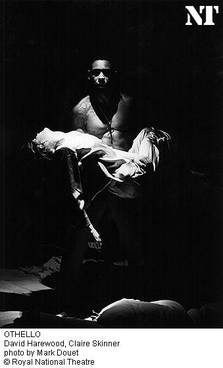
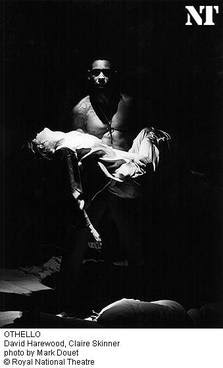
SM I hate bad stage deaths. When someone dies, it takes a long time, particularly when they're suffocated. I think you have to feel the weight of the death, viscerally feel what it's like to kill someone. Also I wanted Desdemona to be someone who fought hard to stay alive. You can tell by the scene that precedes it, she does not want to die. Interestingly enough, the first rehearsal of that scene was incredibly frightening. We worked for three weeks without blocking, stayed in a circle, did the play several times playing the scenes in different ways and doing exercises. And I said to Claire [Skinner] 'I want you to fight him as much as you can'. They had a good notion of the lines because they'd each done the play before, which helped a great deal. And that first time we did Desdemona's death was very, very disturbing. I don't think anyone in the room knew if Claire was acting or not. It turned out she wasn't.

She was panicking because she was claustrophobic, but didn't want to stop because she wanted to know what it felt like. I felt terribly guilty about it - you don't want to put an actor's life in danger, but I knew she was intelligent enough to stop if she wanted to. That is now on stage, and that one rehearsal cracked that scene. She now recalls the panic she experienced that first time. It is an incredibly sordid death and, yes, does de-romanticise it.

SM He's heterosexual. I think he has a fascination with Othello which is not homosexual, but the fascination of a different race, a different physical type, a different mind, a different sexual drive. I don't think he's in love with Othello, but I think that weirdly, as he destroys him, as he becomes closer to him both physically and emotionally and begins to understand how he ticks, it sort of turns him on. It's a power trip, and that can be very sexual. I think that's where it shades over occasionally into accusations of homo-eroticism. But I don't think it's a homosexual love affair, I think Iago has loved his wife, and that one of the crucial motivating factors for him is that he understands jealousy absolutely because he himself has experienced it with his own wife. So to ignite it in someone else is a very easy process. He knows exactly which buttons to press. The crucial button - which he delays and delays, and then eventually says 'Look to your wife' - is so uncannily brilliant it's not possible for Iago not to have experienced it himself. Maybe someone had said to Iago exactly that line about Emilia, and it had been true, maybe just one time, that Emilia had slept with someone else. That in itself is enough to destroy a man, as the play proves.

Audience question

I find it extremely difficult to feel sympathy for Othello's decision to kill Desdemona. How did you find an explanation for that?

SM You can't say 'We're going to explain the text'. It's like the moment Cressida betrays Troilus. She does it. Not all human actions are motivated by lengthy thought, in fact the biggest decisions in one's life are taken perhaps in the final ten seconds before action. You have to build up to that point. Othello kills Desdemona, and then regrets what he's done to such a degree that he kills himself. There could hardly be a greater admission of defeat. So I don't think the play is about how stupid Othello is. What I did go for very strongly is that he has to be emotionally very vulnerable. To that extent, David [Harewood's] youth helps him. I think you understand how a man like that hasn't had the experience of a wife or a permanent lover to fall back on and he begins to question himself. I wanted to make his fear of her loss the greatest motivating factor. I think the crucial speech is the one he delivers at the end of our first act - 'She's gone. I am abused, and my relief Must be to loathe her'. I think there's a great vulnerability, humanity and warmth, despite the fact that he's saying he must loathe her.

He can't see another option; in the first flush of extreme emotion it's very difficult to see your way clear. The skill of the play is that Iago pounces on that and in a very short space of time the whole thing snowballs. By midnight she is dead. It's a very specific timescale. If anything enters that plan of Iago's in that space of time, he's lost the game. But in that time Iago plays a blinder. He doesn't make any mistakes until right at the very end and by that time it's too late. So I think it's about one man's malice and genius, and another man's weakness, but I don't think you should find Othello too much at fault.

Audience question

Could you comment on how Desdemona is played?

SM I depend a great deal, as any director does, on the imagination of actors. You cast somebody who is the right age and type, yes, but also who has the right imagination, the right level of spiritual understanding. Claire is a wonderful and strong presence. Desdemona made a very specific decision to marry this man. It seems to me extraordinary for someone, even now, to creep out of the house at ten o'clock at night and go down the road and marry a large black general without her father knowing. So that's the main thing I had in my mind about the character. You want someone with the courage of her convictions and the presence of mind to make that decision.

GM - You might also ask if what her father and Iago say about her isn't in some sense true. That she has deceived her father and may - indeed possibly does - deceive Othello. There is a conventional way of looking at it, that she is an innocent victim of his insane jealousy and there's another way that says perhaps she's not quite straight...

SM Well she does deceive Othello because she knows the handkerchief is lost and doesn't say so. That's a big mistake. It's a small lie but in terms of the story it's big. And of course, Iago confronts Othello with the single most important piece of information, psychologically, about Desdemona, which is that she tricked her father. If she can do that to her father, a very rich grandee, she can do it to Othello, and Othello can't deny that. Two incontestible pieces of information. He knows she knows the handkerchief is missing, and he knows she betrayed her father. That makes her in some way extremely strong, an active participant in the drama, rather than an insipid feeble girl.

Audience question

I was trying to work out the time span of the play. How long a period does the story cover?

SM There's something rather odd about the timespan. Shakespeare telescopes time. It says they arrive in Venice in three days, and in reality the journey took three weeks, we discovered in doing our research. And there are all sorts of eccentric pieces of timing in the first act. But the point seems to me that when he needs the clock to be ticking specifically, Shakespeare sets it going. Desdemona says to Othello, 'Come in for dinner', so we know it's night time. Then everyone says 'Gosh isn't it dark' and the town's empty, so we know it's late. He spells it out. From Act III onwards the play is very concerned with specifics and domestic detail.

Audience question

Do you think Iago's motives are as clear cut as you state, or do you think he shows a deeper instinctive evil in his character?

SM 'Deeper instinctive evil' - I think that's a generalisation, I don't understand what that is. I think you've got to root it in specific emotions and events. The problem is that Iago specifies so many different reasons for doing what he does. I think he does it for all those reasons, but that doesn't amount to the real reason. I don't think we'll ever really know. The evil, if you like, is compounded of specifics. Character flaws, vulnerability, loss, desperation, ambition, lack of promotion Ð the flaws in him, which he's probably intelligent enough to realise. It's three dimensional and complex beyond my understanding. I can't truly comprehend a man who can do those things, and I think that's why the play is so truly fascinating because it makes evil specific and precise and human.